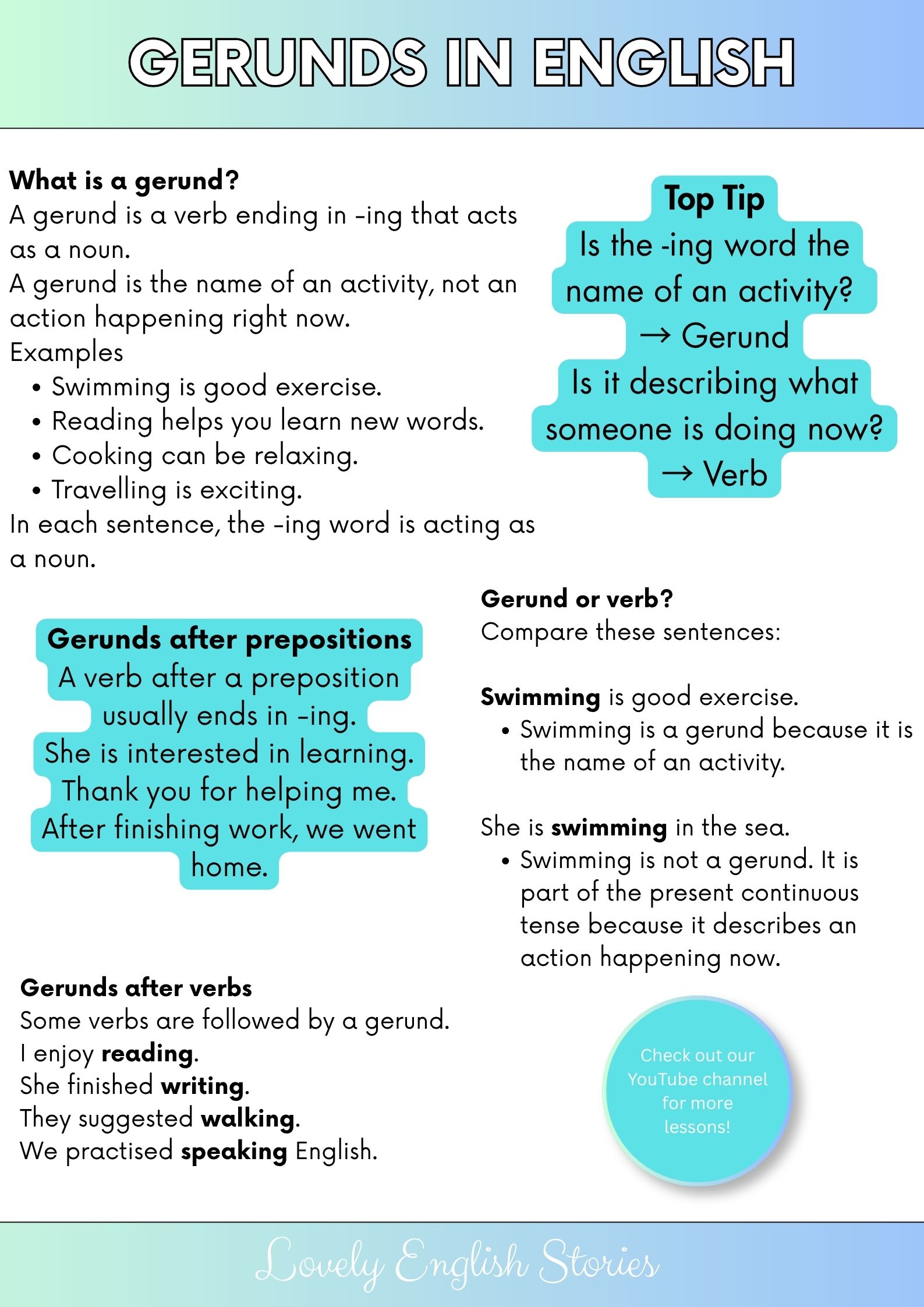
What is gerund? A simple British English guide with PDF
August 8, 2026
Gerunds are very common in everyday English, and once you know how they work, you’ll start noticing them everywhere.
What is a gerund?
If you’re learning English, you’ve probably seen words like swimming, reading, or cooking in different sentences. Sometimes these words describe an action, but other times they act like a noun.
When a verb ends in -ing and is used as a noun, it is called a gerund.
Let’s have a look at an example of a gerund in use:
(to) swim → verb
swimming → gerund (noun)
Swimming is good exercise.
In this sentence, swimming is the subject of the sentence.
Swimming is a gerund because it is acting as a noun, not a verb. It is the subject of the sentence which means the person or thing that the sentence is about.
The sentence isn’t talking about someone who is swimming at this moment. Instead, it is talking about the activity of swimming in general. You could replace swimming with another noun, such as football or exercise, and the sentence would still make sense.
More examples of gerunds
Reading helps you learn new vocabulary.
Cooking can be relaxing.
Walking every day is good for your health.
In all of these sentences, the -ing word is the name of an activity. That is why it is called a gerund.
Now compare it with this sentence:
She is swimming in the sea.
Here, swimming is not a gerund. It is part of the present continuous tense because it describes an action that is happening right now.
A simple way to know if it's a gerund
Is the -ing word the name of an activity? Then it’s probably a gerund.
Is the -ing word describing what someone is doing now? Well, it’s probably part of a verb.
Gerunds after certain English verbs
Some English verbs are followed by a gerund instead of another verb.
Here are some common examples:
enjoy
love
like
dislike
finish
avoid
keep
practise
suggest
recommend
Here’s some examples of them in use:
I enjoy reading books in English.
She finished writing her email.
They avoided driving in the snow.
We practised speaking English together.
He suggested going by train.
These patterns are very common in spoken and written English.
Gerunds after prepositions
You also use a gerund after a preposition such as in, on, at, for, about, before, or after.
Here are some examples:
She is interested in learning Spanish.
Thank you for helping me.
Before leaving, turn off the lights.
After finishing work, we went home.
Remember: if a verb comes after a preposition, it usually needs to be in the -ing form and if you’re interested in learning more about prepositions in English, we have a lesson about prepositions of timeyou can enjoy on our YouTube channel!
Is it a gerund or a verb?
Compare these two sentences:
She is swimming in the sea.
Here, swimming is part of the present continuous tense. It is a verb.
Swimming is my favourite hobby.
Here, swimming is a gerund because it is the subject of the sentence.
Although the words look the same, they have different jobs.
Gerunds are an important part of English grammar.
They are simply verbs ending in -ing that act as nouns.
The more you read and listen to English, the easier it will become to recognise gerunds naturally.
Try writing five sentences about your hobbies using gerunds, such as Reading helps me relax or Cooking is my favourite activity.
Or you could watch some of our Lovely English Stories and try and find the gerunds in the sentences.
Download our free PDF all about gerunds in English!
Right-click and save this PDF so you can learn all about gerunds in English!