
If you want to improve your British English skills, one thing can that really help are idioms. British people use these in everyday conversation without even thinking about it!
If you’re an English teacher, you might find our PDF of 50 English idioms further down the page useful as a handout!
What is an idiom?
An idiom is a group of words that has a meaning that is different from the meaning of the individual words.
This can make idioms difficult for English learners because you cannot always understand them by translating each word.
50 advanced English idioms
To be barking up the wrong tree – to have the wrong idea about something.
If you think I broke the window, you’re barking up the wrong tree.
To have a bee in your bonnet – to be obsessed or very focused on an idea.
She’s got a bee in her bonnet about people using their phones at dinner.
To throw a spanner in the works – to cause a problem that disrupts a plan.
The cancelled train threw a spanner in the works.
To be on the ball – to be alert, capable and quick to understand things.
You need to be on the ball if you want to do well in this job.
To get your wires crossed – to misunderstand someone.
I think we got our wires crossed about what time to meet.
To go pear-shaped – for a situation to go badly wrong.
Our holiday plans went pear-shaped when our flight was cancelled.
To have a chip on your shoulder – to feel angry or resentful because you think you’ve been treated unfairly.
He has a chip on his shoulder about not getting the promotion.
To keep your cards close to your chest – to avoid revealing your plans or feelings.
She’s keeping her cards close to her chest until the interview results are announced.
To put a spanner in the works – to cause something to stop working properly.
The sudden power cut put a spanner in the works.
To be snowed under – to have far too much work to do.
I’m snowed under with work this week.
To be in the same boat – to be in the same difficult situation as someone else.
Don’t worry, we’re all in the same boat.
To bite the bullet – to face something difficult or unpleasant.
I hate going to the dentist, but I’ll have to bite the bullet.
To cut corners – to do something badly or cheaply by taking shortcuts.
The company cut corners, and the final product was poor quality.
To read between the lines – to understand a hidden or implied meaning.
If you read between the lines, you can tell she isn’t happy.
To sweep something under the carpet – to hide or ignore a problem.
We can’t just sweep the problem under the carpet.
To kick something into the long grass – to delay dealing with something, often deliberately.
The government decided to kick the decision into the long grass.
To move the goalposts – to unfairly change the rules or requirements of a situation.
Every time I finish the work, they move the goalposts.
To raise the bar – to increase the standard that is expected.
Her excellent performance has really raised the bar.
To hit the nail on the head – to describe something exactly or identify the main problem.
You’ve hit the nail on the head—that’s exactly the problem.
To get the ball rolling – to start something.
Let’s get the ball rolling and begin the meeting.
To be skating on thin ice – to be in a risky or dangerous situation.
He’s skating on thin ice after arriving late again.
To have your work cut out for you – to have a difficult task ahead.
With only two days to finish the project, we have our work cut out for us.
To be out of your depth – to be in a situation that is too difficult for your ability or experience.
I felt out of my depth when I started my new job.
To put your foot in it – to say or do something embarrassing or inappropriate.
I really put my foot in it when I asked about her ex-husband.
To make a mountain out of a molehill – to make a small problem seem much bigger than it is.
It’s only a small mistake, so don’t make a mountain out of a molehill.
To flog a dead horse – to continue trying to achieve something that is clearly not going to work.
There’s no point arguing about it anymore—we’re just flogging a dead horse.
To take something with a pinch of salt – to not completely believe something.
I’d take what he says with a pinch of salt.
To have bigger fish to fry – to have more important things to deal with.
I can’t worry about that now—I have bigger fish to fry.
To let the cat out of the bag – to accidentally reveal a secret.
Tom let the cat out of the bag about the surprise party.
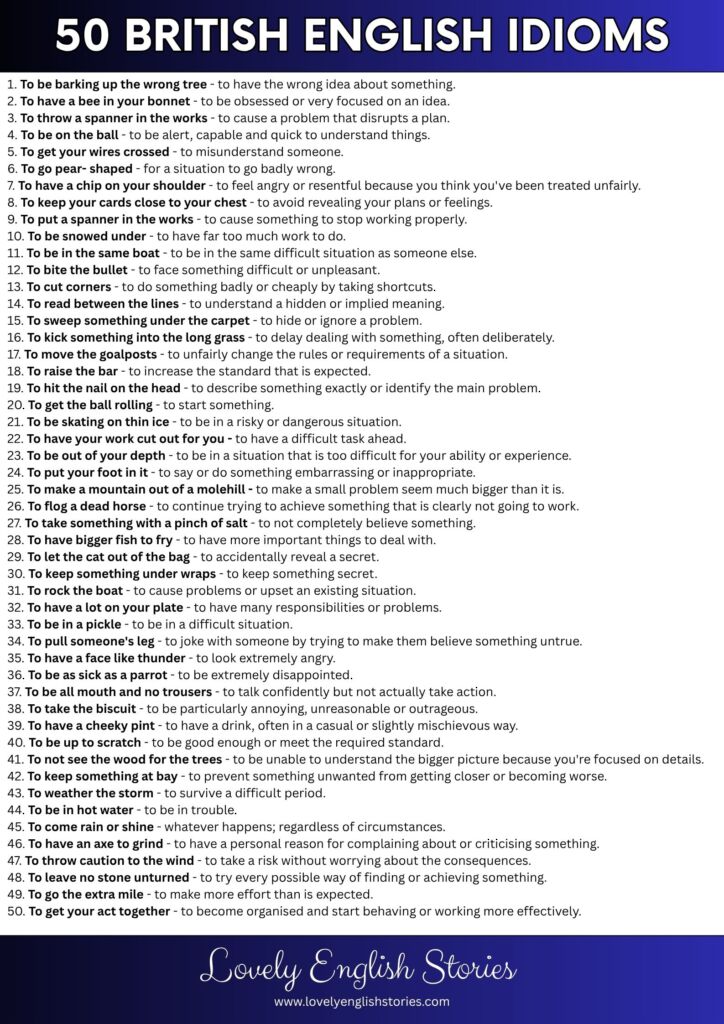
More English idioms!
To keep something under wraps – to keep something secret.
They’re keeping their wedding plans under wraps.
To rock the boat – to cause problems or upset an existing situation.
She didn’t want to rock the boat, so she stayed quiet.
To have a lot on your plate – to have many responsibilities or problems.
I’ve got a lot on my plate at the moment.
To be in a pickle – to be in a difficult situation.
I was in a pickle when I realised I’d lost my passport.
To pull someone’s leg – to joke with someone by trying to make them believe something untrue.
Don’t worry, I’m only pulling your leg!
To have a face like thunder – to look extremely angry.
She had a face like thunder when she saw the mess.
To be as sick as a parrot – to be extremely disappointed.
I was as sick as a parrot when my team lost the final.
To be all mouth and no trousers – to talk confidently but not actually take action.
He says he’ll complain to the manager, but he’s all mouth and no trousers.
To take the biscuit – to be particularly annoying, unreasonable or outrageous.
Being late was bad enough, but forgetting the tickets really took the biscuit.
To have a cheeky pint – to have a drink, often in a casual or slightly mischievous way.
We finished work early and went for a cheeky pint.
To be up to scratch – to be good enough or meet the required standard.
I’m afraid your work isn’t up to scratch yet.
To not see the wood for the trees – to be unable to understand the bigger picture because you’re focused on details.
You’re worrying so much about the small details that you can’t see the wood for the trees.
To keep something at bay – to prevent something unwanted from getting closer or becoming worse.
Regular exercise can help keep stress at bay.
To weather the storm – to survive a difficult period.
The company managed to weather the storm during a difficult year.
To be in hot water – to be in trouble.
He’s in hot water for missing the deadline.
To come rain or shine – whatever happens; regardless of circumstances.
I’ll be there tomorrow, come rain or shine.
To have an axe to grind – to have a personal reason for complaining about or criticising something.
He has an axe to grind because he used to work for the company.
To throw caution to the wind – to take a risk without worrying about the consequences.
She threw caution to the wind and booked a one-way ticket to Australia.
To leave no stone unturned – to try every possible way of finding or achieving something.
The police promised to leave no stone unturned in their search.
To go the extra mile – to make more effort than is expected.
Our teacher always goes the extra mile to help us learn.
To get your act together – to become organised and start behaving or working more effectively.
You need to get your act together if you want to pass the exam.
So, now you know 50 new British English idioms! Now it’s time for you to explore words like cheeky and look at some common adjectives in English.