List of common adjectives in English (with PDF)
If you’re a beginner English learner, here’s where you need to start when it comes to learning English adjectives!
We recommend you learn these and have a look at our 100 beginner words in English to really build you vocabulary.
If you’re an English teacher, then here’s 70 English adjectives your students need to know!
What are adjectives?
Adjectives are an important part of everyday English. We use them to talk about:
- People – She is kind. He is young.
- Objects – The bag is heavy. The book is interesting.
- Places – The city is beautiful. The room is clean.
- Feelings – I am happy. They are tired.
- Food and drinks – The apple is sweet. The soup is salty.
Learning these words helps you describe the world around you and communicate your ideas more easily.
How to learn adjectives
When learning new vocabulary, it is important not just to memorise the meaning of a word, but to practise using it. Try these simple activities:
1. Create your own sentences
After learning a new adjective, write a sentence about your own life.
For example:
- Busy – I am busy today.
- Happy – I am happy because I am learning English.
- Beautiful – My hometown is beautiful.
Using new words in personal sentences helps you remember them for longer.
2. Learn opposite adjectives together (241!)
Many adjectives have an opposite meaning. Learning pairs can make vocabulary easier to remember.
Examples:
- Big ↔ Small
- Hot ↔ Cold
- Good ↔ Bad
- Old ↔ New
- Fast ↔ Slow
- Clean ↔ Dirty
Learning words together helps you understand their meanings more clearly.
3. Practise describing everyday things
Look around you and try to describe what you see.
You might say:
- The table is big.
- The coffee is hot.
- The room is quiet.
- The bag is heavy.
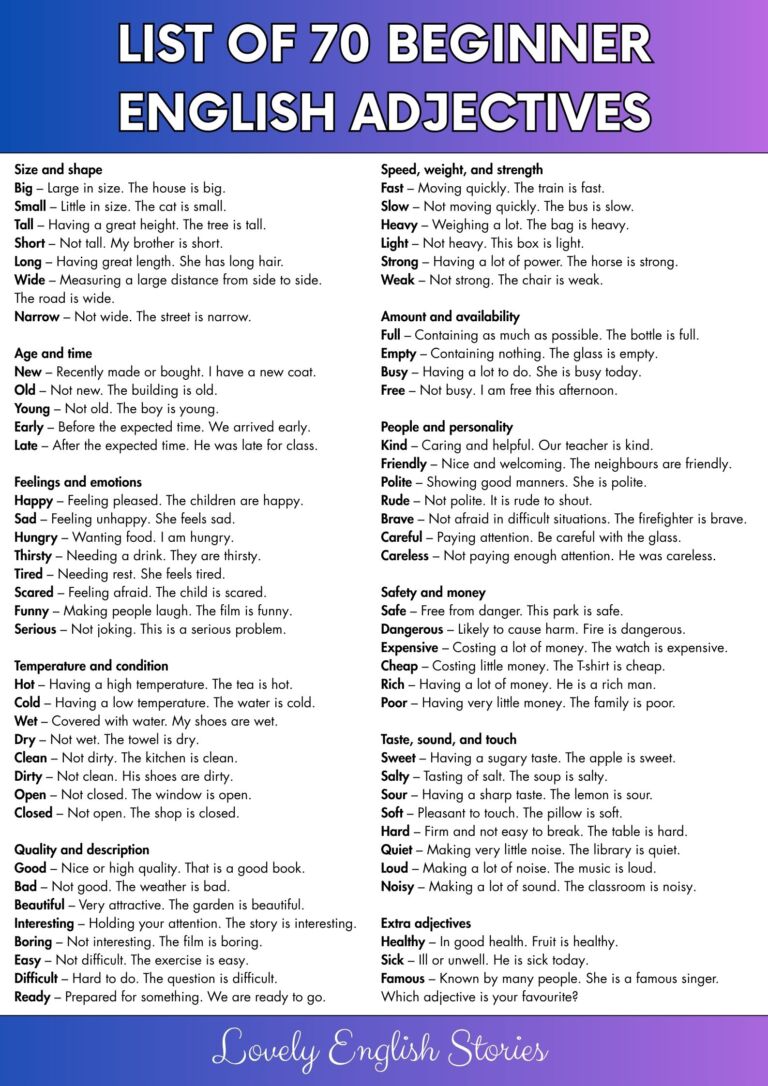
List of 70 beginner English adjectives by topic
Size and shape
These adjectives help us describe the size, height, and shape of things.
Big – Large in size. The house is big.
Small – Little in size. The cat is small.
Tall – Having a great height. The tree is tall.
Short – Not tall. My brother is short.
Long – Having great length. She has long hair.
Wide – Measuring a large distance from side to side. The road is wide.
Narrow – Not wide. The street is narrow.
Age and time
These adjectives help us describe age and when something happens.
New – Recently made or bought. I have a new coat.
Old – Not new. The building is old.
Young – Not old. The boy is young.
Early – Before the expected time. We arrived early.
Late – After the expected time. He was late for class.
Feelings and emotions
These adjectives describe how people feel.
Happy – Feeling pleased. The children are happy.
Sad – Feeling unhappy. She feels sad.
Hungry – Wanting food. I am hungry.
Thirsty – Needing a drink. They are thirsty.
Tired – Needing rest. She feels tired.
Scared – Feeling afraid. The child is scared.
Funny – Making people laugh. The film is funny.
Serious – Not joking. This is a serious problem.
Temperature and condition
These adjectives describe how things feel or their condition.
Hot – Having a high temperature. The tea is hot.
Cold – Having a low temperature. The water is cold.
Wet – Covered with water. My shoes are wet.
Dry – Not wet. The towel is dry.
Clean – Not dirty. The kitchen is clean.
Dirty – Not clean. His shoes are dirty.
Open – Not closed. The window is open.
Closed – Not open. The shop is closed.
Quality and description
These adjectives help us describe things and experiences.
Good – Nice or high quality. That is a good book.
Bad – Not good. The weather is bad.
Beautiful – Very attractive. The garden is beautiful.
Interesting – Holding your attention. The story is interesting.
Boring – Not interesting. The film is boring.
Easy – Not difficult. The exercise is easy.
Difficult – Hard to do. The question is difficult.
Ready – Prepared for something. We are ready to go.
Speed, weight, and strength
These adjectives describe movement and physical qualities.
Fast – Moving quickly. The train is fast.
Slow – Not moving quickly. The bus is slow.
Heavy – Weighing a lot. The bag is heavy.
Light – Not heavy. This box is light.
Strong – Having a lot of power. The horse is strong.
Weak – Not strong. The chair is weak.
Amount and availability
These adjectives describe how much of something there is.
Full – Containing as much as possible. The bottle is full.
Empty – Containing nothing. The glass is empty.
Busy – Having a lot to do. She is busy today.
Free – Not busy. I am free this afternoon.
People and personality
These adjectives describe people’s character and behaviour.
Kind – Caring and helpful. Our teacher is kind.
Friendly – Nice and welcoming. The neighbours are friendly.
Polite – Showing good manners. She is polite.
Rude – Not polite. It is rude to shout.
Brave – Not afraid in difficult situations. The firefighter is brave.
Careful – Paying attention. Be careful with the glass.
Careless – Not paying enough attention. He was careless.
Safety and money
These adjectives describe danger and cost.
Safe – Free from danger. This park is safe.
Dangerous – Likely to cause harm. Fire is dangerous.
Expensive – Costing a lot of money. The watch is expensive.
Cheap – Costing little money. The T-shirt is cheap.
Rich – Having a lot of money. He is a rich man.
Poor – Having very little money. The family is poor.
Taste, sound, and touch
These adjectives describe our senses.
Sweet – Having a sugary taste. The apple is sweet.
Salty – Tasting of salt. The soup is salty.
Sour – Having a sharp taste. The lemon is sour.
Soft – Pleasant to touch. The pillow is soft.
Hard – Firm and not easy to break. The table is hard.
Quiet – Making very little noise. The library is quiet.
Loud – Making a lot of noise. The music is loud.
Noisy – Making a lot of sound. The classroom is noisy.
Extra adjectives
Common adjectives that English Speakers regularly use.
Healthy – In good health. Fruit is healthy.
Sick – Ill or unwell. He is sick today.
Famous – Known by many people. She is a famous singer.
Which adjective is your favourite?