English grammar lesson: Prepositions of time – IN, AT, ON
Do you want to know how to use prepositions of time in English?
It is very important to know when and how to use prepositions of time for your IELTS, TOEIC or Cambridge English language exam. Prepositions are a common grammar mistake in English.
In this article, we will go over the basics of using prepositions of time in British English conversation – IN, ON and AT. We will show you sample sentences using the English prepositions of time in use… and we also have a video on this very topic which you can watch below.
Looking for a pdf download? Scroll down to find a poster you can save all about these wonderful prepositions.
What are prepositions?
Prepositions are small words but they make a huge difference when you are practising English. It’s important to get them right, otherwise, it might change the meaning of a sentence.
Today, you will learn how to use the preposition of time IN, the preposition of time ON, and the preposition of time AT.
What are the different types of preposition?
The different types of preposition are:
- Prepositions of Place
- Prepositions of Time
- Prepositions of Direction (Movement)
- Prepositions of Manner or Means
- Prepositions of Cause or Reason
- Prepositions of Purpose
- Prepositions of Possession or Relationship
- Prepositions of Agency
…. but today, we’re focusing on time!
The preposition of time – IN
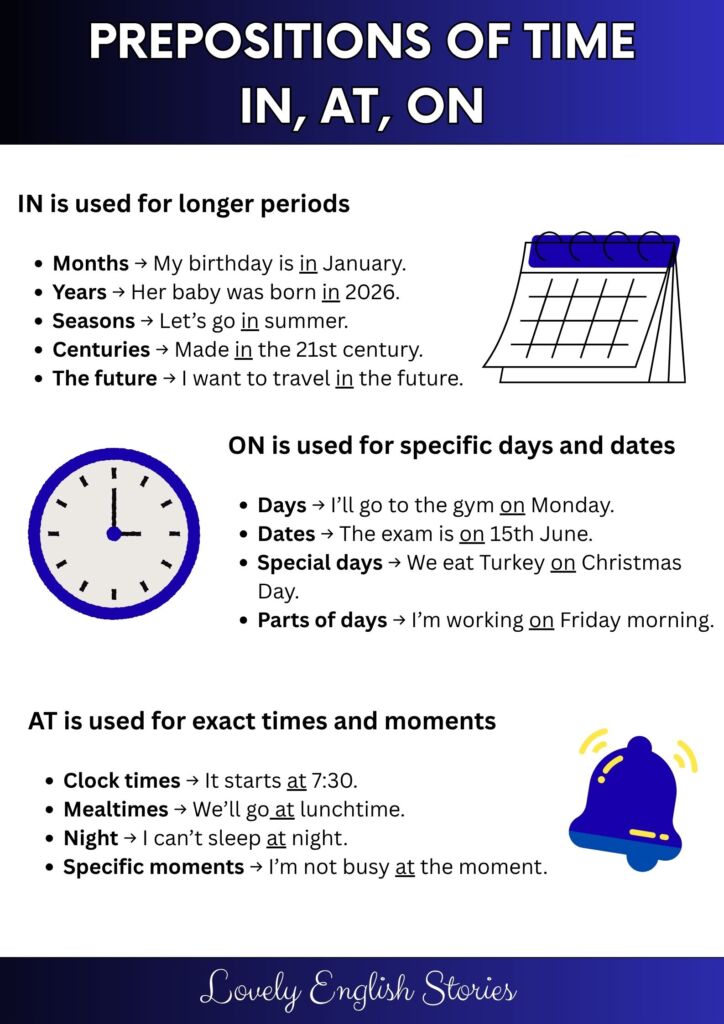
The preposition IN is used to talk about longer periods of time. We use in when referring to months, years, seasons, centuries, and longer periods. It helps show that something happens within a general time frame rather than at a specific moment.
We can use in when we are talking about when something happens in relation to a larger period of time. For example, we say someone was born in 2005, a holiday happens in December, or something changes in the future.
Examples of IN:
My family moved here in 2019.
We usually go on holiday in August.
The flowers bloom in spring.
The preposition of time – AT
The preposition at is used to talk about specific points in time. We use at when referring to exact times on the clock, particular moments, and certain fixed time expressions. Unlike in, which is used for longer periods, at focuses on a precise time.
We also use at with some common time expressions such as at night, at the weekend, and at lunchtime. It helps identify a specific point when an action or event happens.
Examples:
The meeting starts at 9 o’clock.
She usually goes to bed at night.
We will arrive at lunchtime.
The preposition of time – ON
The preposition on is used to talk about specific days and dates. We use on when referring to a particular day of the week, a special day, or a specific date. It helps show the exact day when something happens.
We can also use on with days that include a part of the day, such as on Monday morning or on Friday evening. Unlike in, which is used for longer periods, and at, which is used for exact times, on is used for specific days and dates.
Examples:
I have a meeting on Monday.
Her birthday is on 15th June.
We are visiting our family on Christmas Day.
So, is that a little clearer? Remember, understanding the difference between in, on, and at can make talking about time much easier.
Although these three prepositions can sometimes be confusing, remembering this simple rule can help (so maybe give it a screenshot!):
- Use in for longer periods of time, such as months, years, seasons, and centuries.
- Use on for specific days and dates.
- Use at for exact times and specific moments.
Use the poster below as a quick reminder whenever you need help deciding whether to use in, on, or at when talking about time.